
On March 24, 2026, Linear's CEO Karri Saarinen posted a public letter titled "Issue tracking is dead."
Same week, Notion shipped Custom Agents — fully autonomous AI agents that don't need a human prompt; give it a task and a trigger, it runs 24/7. Basecamp's DHH stepped out to announce that Basecamp is now fully agent-accessible — API refactor, a new CLI, an Agent Skill bundle. Figma had launched "Skills" the day before. Shopify is pushing Shopify Magic. HubSpot is restructuring as an AI customer platform.
Everyone is doing the same thing: turning their core interface from a tool humans operate into a platform agents operate.
The 2026 SaaS industry is going through a collective identity crisis. Every company is asking the same question — if AI agents can do the work for users, does my UI still have a reason to exist?
"Issue Tracking is Dead" — Linear's bet
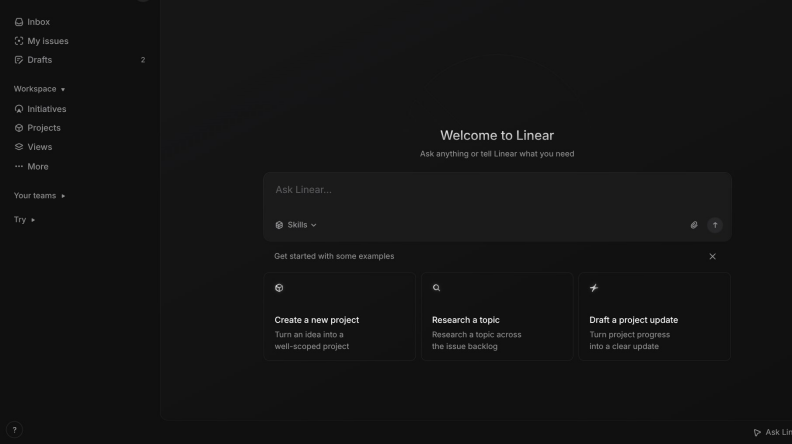
Open Linear and you're greeted not by a board but by a chat box — 'Ask Linear...'
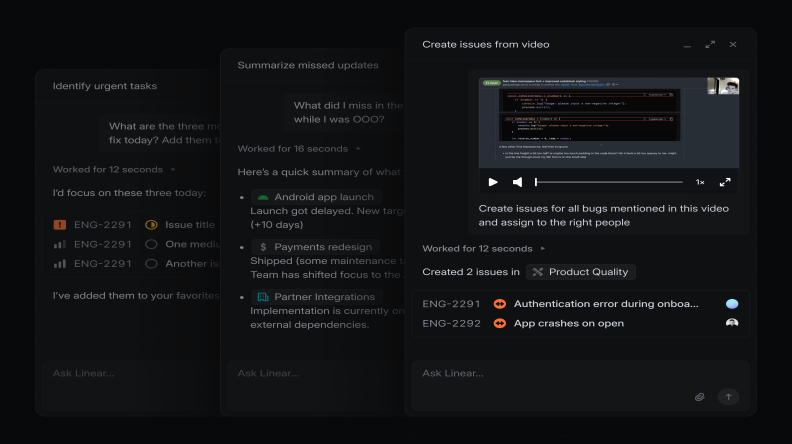
Three typical uses: surface urgent tasks, summarise missed updates, auto-create issues from video.
Linear is the loudest move in this batch, with the biggest action.
Saarinen's argument isn't complicated. Traditional issue tracking was designed for a hand-off model. PM writes a spec, files a ticket. Engineer picks it up. The system bridges the gap with priorities, sprints, status transitions.
That model assumes humans are the executor. When agents become the executor, the entire hand-off chain becomes overhead. Agents don't wait for sprint planning. They need context.
The three data points he cited: 75% of Linear's enterprise customers have installed a coding agent. Agent workload up 5× in three months. 25% of new issues are agent-created.
Linear shipped three things —
- Linear Agent. Chat UI embedded in the product (Cmd/Ctrl+J). Talk in natural language to file issues, organise backlog, write specs, summarise project progress. Reads your roadmap, issue history, and code repos.
- Skills. Reusable workflows. Land a good pattern with the agent, save it as a Skill, replay with one tap. Same concept Figma shipped the day before — Skills is becoming 2026's standard term for agent interaction.
- Automations. When an issue enters Triage, the agent kicks in automatically. Business and Enterprise only.
Code Intelligence (agent that understands your code) and a coding agent that writes fixes are previewed but not shipped.
Community reaction
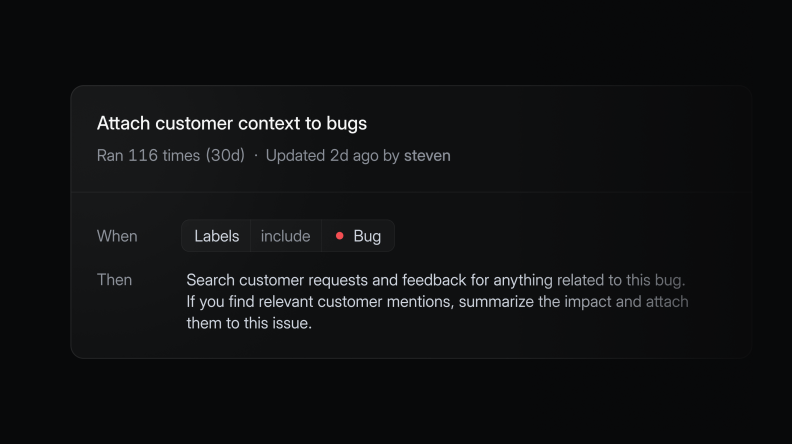
'When a label contains Bug, auto-search customer feedback and attach context' — run 116 times, unattended.
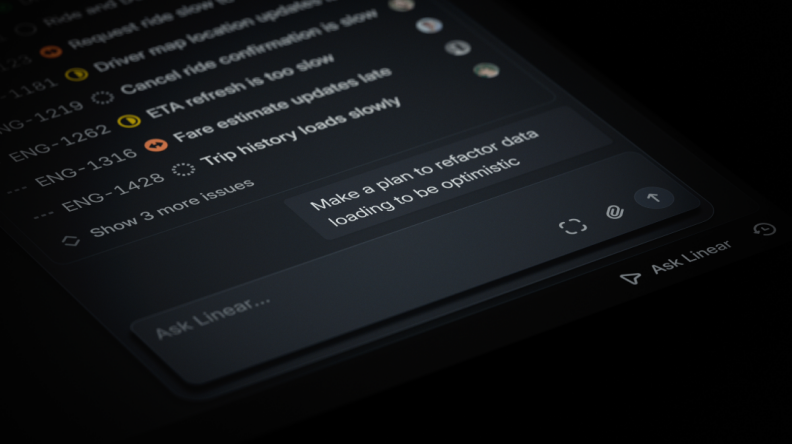
'Ask Linear...' — the chat input floating above the issue list, Linear's new entry point.
Linear's Slack community is broadly positive, mostly asking about MCP support. A Linear employee replied: "we're working on MCP support."
Hacker News was cooler. The standout comments:
"I've always thought Linear was a careful, restrained company. This sudden declaration makes it feel like they're in some internal existential crisis." — steve_adams_86
"Writing your own eulogy isn't just a Stanford MBA assignment any more." — demuis
"This industry is becoming so boring." — ezekg
The deepest objection came from aurareturn: customer feedback comes in via phone, forms, meetings, Twitter; internal discussion happens in Slack/Teams. Linear wants to be the context hub, but a real AI agent would route around tools like Linear — it joins the Slack channel like another colleague, sits in the Zoom, reads the company files. No intermediary needed.
Linear's people replied on HN: agents already exist in Slack, Intercom, Zendesk, Gong, etc. Someone asked "why not just use Claude Cowork + MCP?" Linear's answer: Claude Cowork is a personal tool; Linear is the multi-person system of record. Different positioning.
The point. Linear's bet is fundamentally context monopoly — your roadmap, issues, code, customer feedback all live with me, so I'm the best agent hub. Whether they win depends on whether teams are willing to pour all their context into one tool.
Everyone is doing the same thing
Notion — Custom Agents
'Your 24/7 AI team' — Notion Custom Agents' vision: AI as colleague, not assistant.
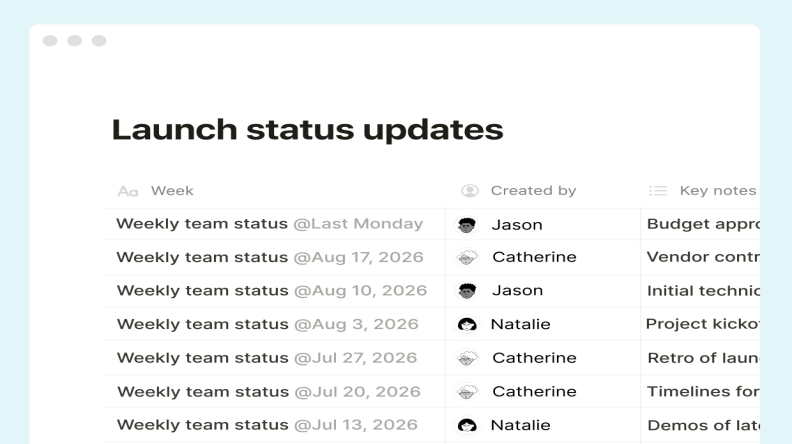
'Launch status updates' — agent-generated weekly reports, no manual filling.
February 24. Notion launched Custom Agents. Completely different from the previous Notion AI (which was essentially a Copilot). This time: fully autonomous. Give it a task, set a trigger or schedule, it runs 24/7.
What can it do? Auto-triage, internal Q&A, daily standup reports, even inbox-zero. Supports MCP for Slack, Figma, Linear, HubSpot. A line from Vercel: "Soon the number of agents running inside Vercel may exceed the number of employees."
Pricing: credit-based. Free trial until May 4, then pay per credit. Same shape as Linear's "core free, advanced metered" approach.
Basecamp — DHH's pragmatic line
March 25. DHH posted Basecamp becomes agent accessible.
37signals's move is different from Linear's and Notion's. No embedded AI inside the product. Instead, they turn Basecamp into infrastructure that agents can operate — refactored the API, built a CLI, wrote Agent Skill docs that teach agents how to use it.
DHH was honest about why: 18 months of trying AI features in-product, none of it was good enough to ship. But agents are AI's killer app. Rather than cram AI features inside the product, let external agents flow freely in and out of Basecamp.
He picked the opposite path from Linear/Notion: don't be the agent. Be the agent's workspace. Use Claude Code, Cursor, your own homegrown agent — as long as it can call Basecamp's CLI.
Figma — Skills
Figma launched "Skills" — reusable AI workflows — the day before Linear. Combined with Figma Make (AI prototyping), Figma Draw (AI-assisted drawing), Figma Sites (AI site builder), Figma's AI layout inside design is now substantial.
Figma's market context matters: after IPO, the stock dropped 85% from peak. The market's panic about "design tools being replaced by AI" is real. Figma's strategy — if AI is going to replace designers, Figma had better be the one doing the replacing.
Why now? Three forces converging
1. Agents crossed the usable threshold
2024's AI Copilots were essentially fancy autocomplete. 2025–2026's agents do multi-step reasoning, call tools, operate across systems. Claude Code, Cursor, Codex are deployed in enterprise at scale. Linear's 75% adoption number isn't a proof-of-concept stat — that's production.
2. MCP became the de facto standard
Anthropic's Model Context Protocol lets agents connect to any tool via a standardised interface. Notion's Custom Agents use MCP for Slack, Figma, HubSpot. Linear is rushing MCP support. Basecamp's Agent Skills are essentially the same interface layer.
MCP's significance: agents no longer need bespoke integrations for each tool. With MCP, one agent can drive Linear, Notion, GitHub, Slack simultaneously. That makes "which tool is the agent's hub?" an actual competitive battlefield.
3. The pricing model is being upended
Per-seat SaaS — $8–$16/mo per user. If agents replace half the human operations, seat counts drop. Deloitte forecasts that by 2030, 40%+ of enterprise SaaS spend shifts to usage / agent / outcome pricing.
Linear and Notion are already exploring — basic chat free, automations metered. The signal: SaaS's value unit is shifting from "time a human spends staring at a screen" to "tasks an agent completes."
Back to Apple — the giant's dilemma and SaaS's dilemma are the same dilemma
I wrote a deep dive on Apple's AI mess earlier. The core observation was: Apple has the technology (chips, privacy architecture, MLX), but can't execute organisationally (Siri infighting, four delays, retired AI lead).
Looking at SaaS's collective transition now, the underlying logic is the same: AI isn't a feature you bolt on. It demands the product be re-designed from the interaction paradigm down.
The lessons from Apple:
-
Speed. When ChatGPT shipped in 2022, Apple execs internally said "chatbots aren't very useful." Two years later, they were forced to license Gemini from Google. In AI, being half a step late is being a generation late. Linear clearly learned — even with the product still in beta, declare early and claim position.
-
Positioning. Apple went from "collecting rent" ($20B/year from Google for default search) to "paying rent" ($1B/year for Gemini). SaaS companies face the same choice — are you the agent's operator, or the agent's infrastructure? Linear picked the former. Basecamp picked the latter. Wrong answer turns a platform into a pipe.
-
Open vs closed. Apple cracked down on vibe-coding apps (Replit, Vibecode), trying to use review power to control AI-built app distribution. They infuriated the developer community. SaaS companies have gone the opposite way — Linear lets Claude Code, Cursor, Codex open issues directly. Basecamp opens the CLI. But openness has a cost: if agents can operate your data freely, where's your moat?
The chat-interface trap — even Linear's CEO admits it
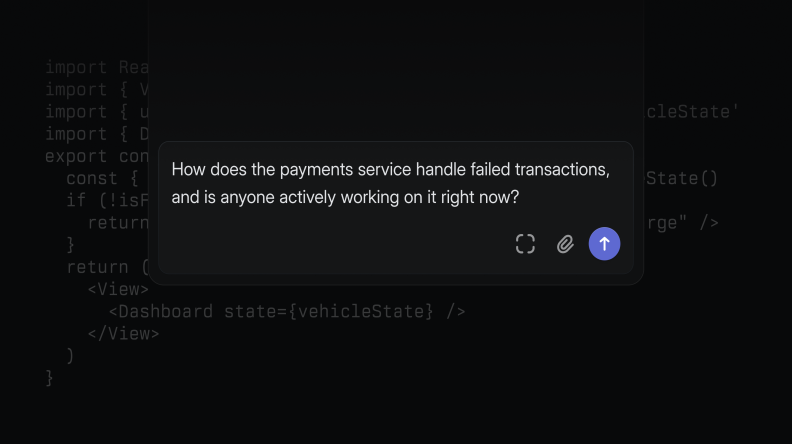
Chat on top of code — Linear Code Intelligence lets non-technical people ask code questions.
Most worth-watching detail in this whole transition.
Days after Linear Agent shipped, Saarinen posted a design-reflection piece on every.to. He explicitly conceded the fundamental flaws of the chat interface:
"The more I use Chat, the more I see its weaknesses. Everything turns into a stream of text — hard to preserve, compare, connect to other work. Output quality depends entirely on input quality — two people asking the same question can get completely different answers. The interface is essentially a blank page with a blinking cursor, and the entire burden of extracting value falls on the person typing."
Chat is good for exploration, bad for serious, repeated team work. Linear's own CEO knows this.
His conclusion is that you need structured interaction design layered on top of chat — guide users and agents toward better outcomes without becoming rigid. A real design challenge. Nobody's solved it well yet.
My read: this is exactly why the SaaS Hunger Games is far from over. Everyone is running toward Chat/Agent, but Chat itself may not be the endgame. The winner won't be the company that added a chat box first. It'll be the one that finds the interaction paradigm that comes after Chat.
SaaS stocks are crashing — the market is already pricing the transition
The 12-month numbers, brutal:
| Company | Drop | Context | |---|---|---| | HubSpot | -50%+ | Category leader; AI threatens high-margin workflows | | ServiceNow | -30–40% | Analysts publicly discussing "SaaS is dead" | | Monday.com | -40%+ | Product and growth strong, market not buying | | Atlassian | Double digits | Deep developer network, still sold off | | Adobe | -30–35% | Shipped AI features; stock kept falling | | Salesforce | -25–30% | Deepest enterprise embed, still hammered | | Figma | -85% from peak | Post-IPO collapse; replacement panic |
These aren't speculative names. These are mature, cash-flow platform companies. The market is doing one thing: pricing AI disruption risk at the maximum. Especially horizontal, per-seat, SMB-facing SaaS.
Jensen Huang said something contrarian at the Cisco AI Summit: "AI replacing the software industry is the most illogical sentence in the world. AI will use existing tools, not reinvent them."
But Jensen's point is that AI needs the infrastructure underneath software. It does not need your UI. If agents can call APIs directly to get the job done, what is your carefully polished dashboard for, and to whom?
Three paths, three bets
The strategies I'm seeing fall into three buckets.
Path A — be the agent (Linear, Notion)
Embed an AI agent in the product. Chat UI for human-agent interaction. The agent understands your data and workflow, executes for you.
Bet: context is the moat. Roadmap, backlog, customer feedback all in my database; other agents can't reach it.
Risk: if general agents (Claude Cowork, ChatGPT) can read the same data via MCP, your embedded agent has no advantage. More dangerously, users may trust the general AI they already use over your specialised one.
Path B — be the agent's infrastructure (Basecamp)
Don't build the agent. Build the platform agents operate on. Open the API, CLI, Skill docs. Let external agents come and go freely.
Bet: agents need a reliable workspace for data, state, team coordination. Whichever agent you use, you need Basecamp.
Risk: if you're just a database agents operate, your competitive moat decays into API quality and data migration cost. Many teams may just use Google Docs + MCP.
Path C — do both (Shopify)
AI features in the product (Shopify Magic) plus open API for external agents. Be the user's Copilot and the agent's infrastructure.
Bet: e-commerce is too vertical, too complex, for general agents. Users need an AI that understands commerce.
Risk: doing both means doing both okay. Resources spread thin.
Five judgements
1. Issue tracking is dead is marketing copy, not product fact. Linear themselves said it — the Issue is still the core data unit. What's dead is humans manually filing issues, manually changing status, manually following up. Agents will auto-file and auto-update. The Issue doesn't disappear. The creator just changes from human to machine.
2. Chat isn't the endgame. Even Saarinen admitted the flaws. 2026's chat UI is like 2007's touchscreen — direction's right, interaction paradigm not mature. Whoever finds the Chat + structured action hybrid first wins the next decade.
3. The real winners aren't SaaS companies. They're agent platforms. Anthropic (Claude Code + MCP), OpenAI (Codex + ChatGPT), Google (Gemini + Agent Space) — these three are the actual context hub candidates. Whatever SaaS companies do, their underlying model capability is somebody else's product. As I said in the Apple piece — "renter becomes rent-payer." How smart Linear's agent is depends on Claude or GPT, not on Linear.
4. For founders, this is a huge window. While every SaaS giant is rebuilding their interaction paradigm, their UX goes through a no-man's-land transition. Old UI still there, new agent unreliable. If someone can ship an agent-native product in a vertical scenario — not bolting chat onto an old product, but designed around agents from day one — the opportunity is large.
5. Security and trust are dangerously under-invested. The Register noted that Linear Agent's entire security documentation is one sentence: "the agent operates within your existing permission scope." One sentence. For an agent that can auto-file issues, modify projects, read customer feedback. Notion is slightly better — permission control and operation logs. The industry's investment in agent security is far short of what it needs.
The SaaS industry reminds me of the 2007 mobile industry. Before iPhone, Nokia / Motorola / BlackBerry each had their own keyboard scheme. Then a touchscreen changed everything. Today's SaaS companies are like those mobile makers — everyone knows AI agents are the future, everyone's running that direction, but nobody knows exactly what the endgame looks like. Linear thinks it's Chat + context. Basecamp thinks it's CLI + open API. Notion thinks it's autonomous agents + MCP ecosystem.
One thing's certain: whoever's interaction paradigm gets proven right is the winner of the next decade.
Not best AI capability — that's the model company's domain. Not most data — data flows through MCP. Whoever wins the interaction paradigm takes everything.
The same way touchscreens won mobile, the way the mouse won PC.
That answer hasn't been found yet in 2026.