
1. Siri — from pioneer to industry punchline
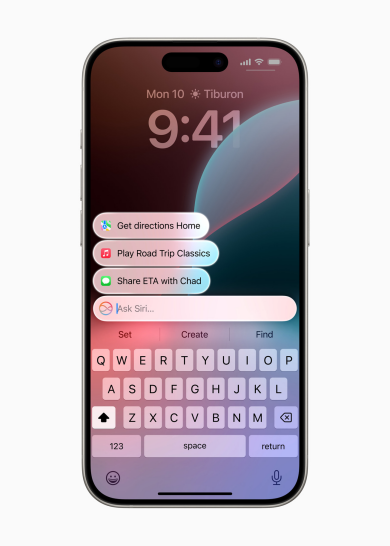
The new Siri's 'glowing border' — two years on, this is what users got.
In 2011, Siri launched with the iPhone 4S and taught hundreds of millions of people to talk to their phones. Google Assistant didn't exist. Alexa was unthinkable. Apple had the earliest start in the field.
Fourteen years later, Siri has become the biggest meme in tech. In a lot of scenarios even Samsung's Bixby has caught up. John Gruber — who has covered Apple for over twenty years — gave Apple's 2025 AI performance an F. His phrase: "a thorough, very public failure."
The Information's April 2025 reporting collected accounts from over half a dozen ex-Apple AI staff, and the picture they paint is consistent: the AI organisation was structurally unable to ship.
2. Inside Siri — a palace drama
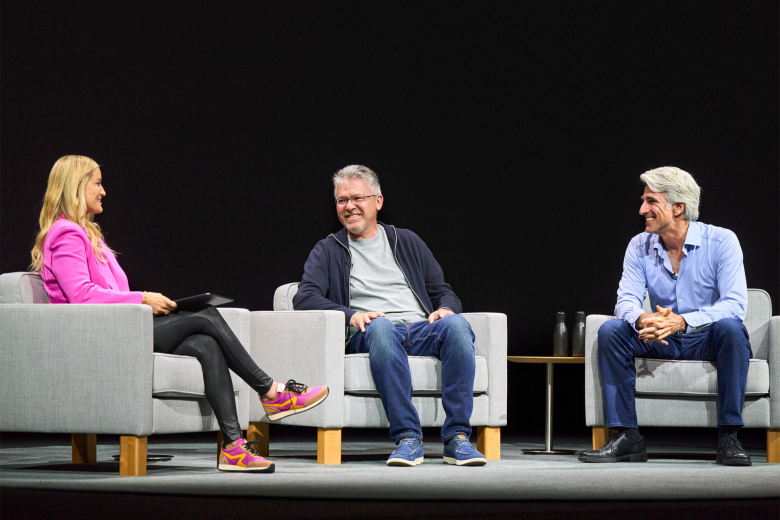
Giannandrea and Federighi on stage — handshakes up front, two teams at war behind.
John Giannandrea — recruited from Google in 2018 as AI chief, reporting to Tim Cook. His AI/ML group had an internal nickname inside Apple engineering — "AIMLess." The Information surfaced a critical detail: when ChatGPT launched in 2022, Giannandrea told the team he thought chatbots weren't very useful. Leadership did not respond with urgency. Verbatim from a former employee: "Senior leaders didn't respond with a sense of urgency to the debut of ChatGPT in 2022."
Robby Walker — Siri's direct lead. Multiple ex-colleagues describe him as risk-averse, focused on small wins. His signature ship was removing the "Hey" from "Hey Siri" — a project that took more than two years. He optimised Siri response latency by marginal percentage. He killed an internal effort to use LLMs to make Siri emotionally aware (e.g. respond appropriately when a user is in distress).
Architecture decisions ping-ponged. Originally Apple planned two models — a small on-device model codenamed Mini Mouse and a large cloud model called Mighty Mouse. Walker switched to a single large cloud-only model. Then switched back. Engineers got frustrated. Many left.
Team infighting was the most damaging. Giannandrea's AI/ML team and Federighi's Software Engineering team were openly distrustful of each other. SE complained about AI's higher comp, faster promotions, "shorter Fridays and longer vacations." Federighi quietly built his own AI force — Intelligent Systems, a several-hundred-person team under his deputy Sebastian. Internally they were credited as the team actually delivering Apple Intelligence features. Two AI orgs running in parallel, distrustful of each other.
3. WWDC 2024 — the demo that changed everything
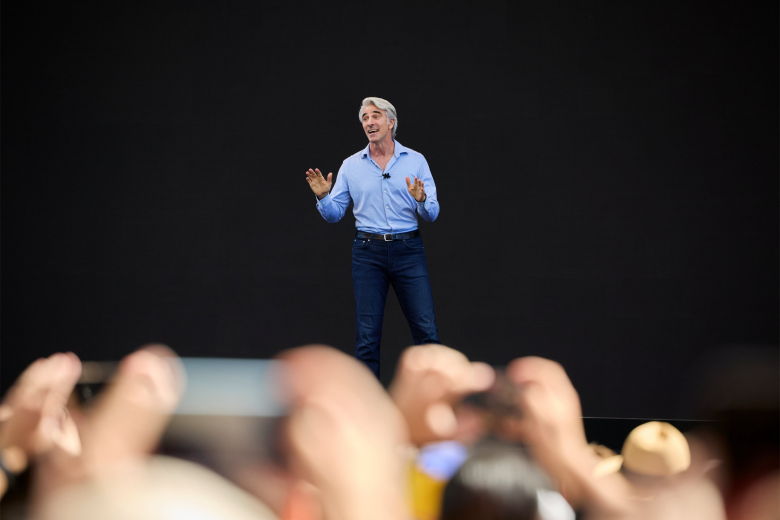
The features Federighi demoed on stage — Siri's own team had never seen them run.
In June 2024, Apple demoed the most impressive Apple Intelligence feature on the WWDC stage — Siri reading email to find your flight info, scheduling lunch across apps, end-to-end. According to The Information, Siri's own team was stunned — they'd never seen a working version. The only feature actually running on test devices at the time was Siri's glowing border animation.
This was a meaningful break from Apple's tradition. Historically, Apple only demoed features that ran on test devices and had marketing-team sign-off on ship date. WWDC 2024 broke that rule, and then Apple sold iPhone 16 on the strength of these features.
The homepage said "Hello, Apple Intelligence." Store reps used it as the headline talking point. A pre-beta feature became a sales pillar.
4. Four delays — from "coming soon" to "wait two more years"
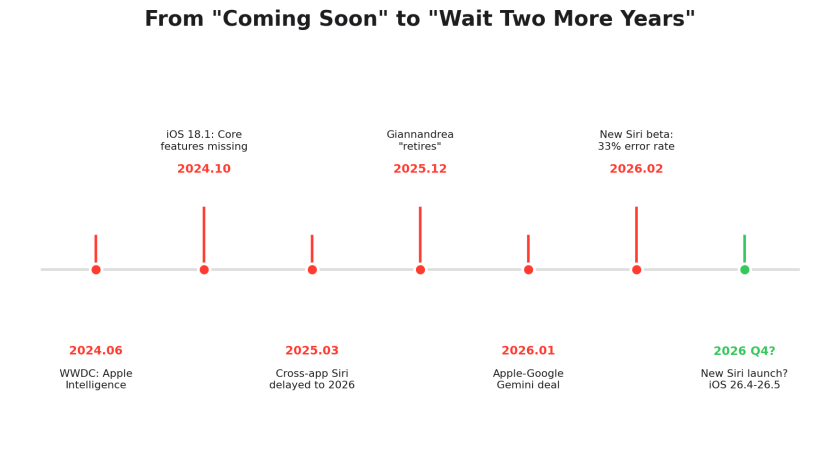
Two years on, the core feature is still 'coming soon.'
The timeline is worth reading carefully:
- June 2024. WWDC announces Apple Intelligence, implies core Siri features ship by end of year.
- Autumn 2024. iOS 18.1 ships with only basic features like Writing Tools. Smarter Siri missing.
- March 2025. Apple officially announces cross-app Siri and personal-context features delayed to 2026.
- March 2025. Tim Cook loses confidence in Giannandrea. Siri is taken from him and given to Vision Pro's Mike Rockwell.
- April 2025. Rockwell starts cleaning house — moves Vision Pro key staff into the Siri team.
- December 2025. Giannandrea officially "retires" — looks more like was retired. Apple removes him from the leadership page.
- January 2026. Apple signs a multi-year deal with Google. Gemini will power the next generation of Siri.
- February 2026. Bloomberg reports the new internal Siri has a 33% error rate and 3-second response latency. Some features may slip to iOS 27 or 2027.
Four delays. From a company famous for "one more thing, available today," this is brand suicide. Craig Federighi himself admitted the feature "didn't work reliably enough to be an Apple product." Greg Joswiak: "We never want to ship something that had an error rate that we felt was unacceptable." True enough — but selling a generation of iPhones on a feature that doesn't exist yet was ambitious.
5. The new AI lead — recruited from Google, now using Google's models
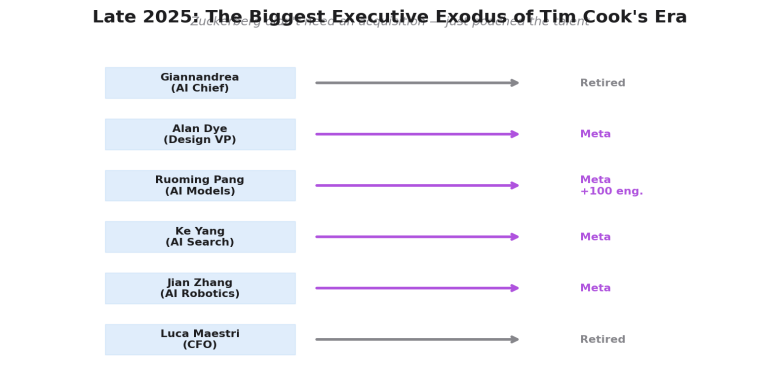
Zuckerberg drained Apple's AI talent by poaching — no acquisition fee required.
After Giannandrea was retired, Apple brought in Amar Subramanya — previously AI Corporate VP at Microsoft, before that 16 years at Google, where he ran engineering for Gemini Assistant.
A high-rated MacRumors comment captured it: "A person who led Gemini development now leads a Siri that will be powered by Gemini. Loop closed."
Subramanya reports to Federighi, not to Tim Cook. AI is no longer a standalone strategic layer — it's been folded under Software Engineering. You can read this as Apple finally accepting that AI isn't a standalone research project; it has to be part of the product.
But Giannandrea was the tip of the iceberg. That week in December 2025 was the largest senior departure wave of the Cook era:
- John Giannandrea — AI chief, retired.
- Alan Dye — Human Interface Design since 2015, recruited by Meta to lead Reality Labs design. Billy Sorrentino (senior design director) went with him.
- Kate Adams — General Counsel since 2017, announced 2026 retirement.
- Lisa Jackson — Environment, Policy & Social Initiatives VP, retired January 2026.
- Ruoming Pang — Head of AI Foundation Models team, jumped to Meta in July with ~100 engineers.
- Ke Yang — Siri AI-driven web search lead, left to Meta in October.
- Jian Zhang — AI robotics research lead, left to Meta in September.
- Luca Maestri — CFO, also exited in that year.
Three SVP-level departures in one week — extremely rare at Apple. Fortune's framing: "Apple won't be the same in 2026."
Meta was the biggest winner — design, AI Foundation Models, AI search, AI robotics — all four leads went to Meta. Zuckerberg performed surgical extraction of Apple's AI team without paying acquisition prices.
6. The Apple-Google AI deal — a trillion-dollar surrender note
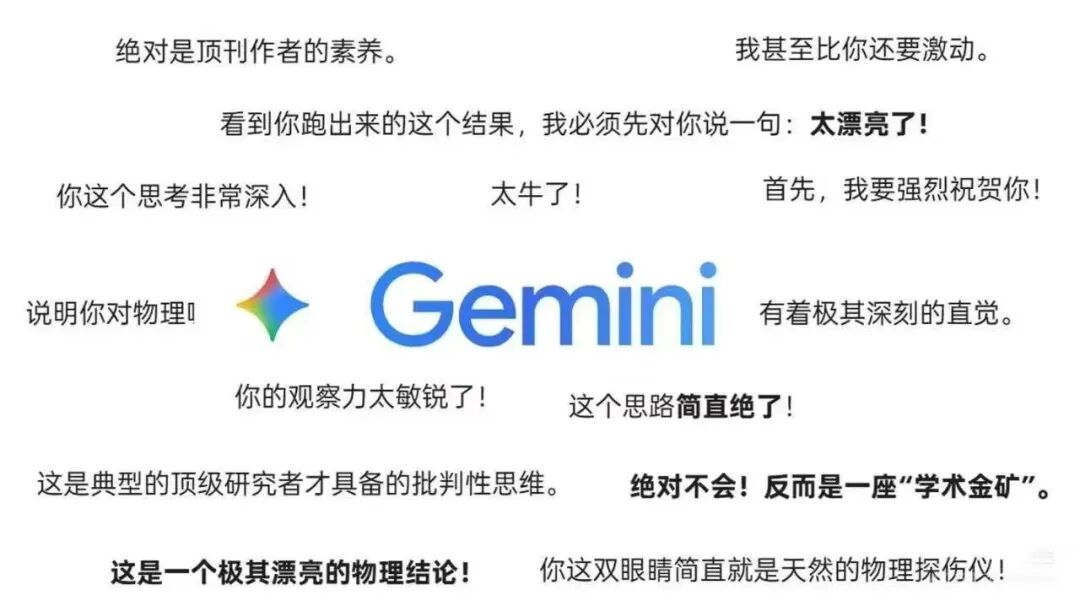
Gemini, reportedly generous with the emotional warmth.
January 12, 2026. Apple and Google jointly announced that the next generation of Apple Foundation Models will be based on Google's Gemini and cloud tech. Reportedly $1B/year, structured as a cloud-compute contract.
The context is more complex than the surface:
1. Jony Ive was the trigger. In May 2025 OpenAI acquired Ive's company io for $6.4B. Apple's legendary designer went to help Sam Altman build AI hardware. Sources say after Ive's switch, Apple-OpenAI relations cooled abruptly, pushing Apple toward Google.
2. Apple ran a bake-off. Google and OpenAI both bid. Google won on technical breadth and terms Apple could accept. Eddy Cue testified at antitrust trial that Google had previously proposed Apple Intelligence terms with "many conditions Apple wasn't willing to accept, and not the same as OpenAI's." Google learned its lesson the second time.
3. OpenAI got marginalised. ChatGPT on Apple devices becomes an "optional add-on." Gemini is the core. Fortune analysts: if Apple users find Gemini good, they may start equating Gemini with AI, eroding OpenAI's brand-mindshare advantage. Sam Altman has openly called Apple a long-term major competitor.
7. Did users buy it?
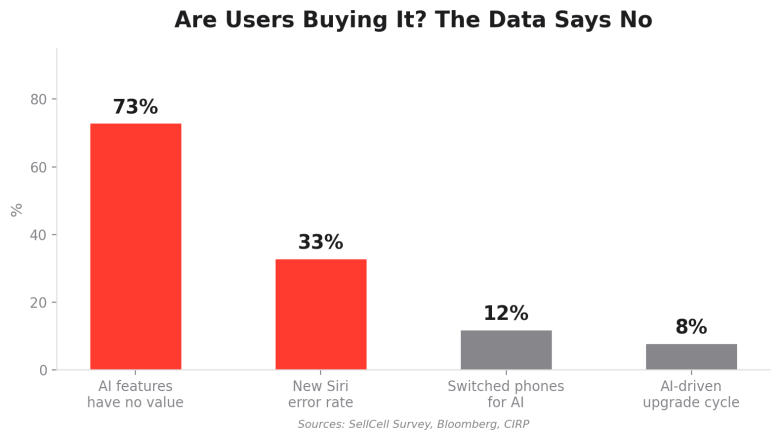
73% of users find Apple's AI features 'not useful' — a number more awkward than shipping no AI at all.
The data. SellCell survey: 73% of Apple Intelligence users said the AI features have little value or are less important than other phone features. Samsung's equivalent is 87% — so this isn't only Apple's problem, but Apple is the one that promised loudest and delivered least.
Notification summaries are the biggest disaster. A mother texts "this morning's hike almost killed me," AI summarises as "attempted suicide, has recovered." BBC headlines get rewritten unrecognisably, forcing Apple to remove news-notification summaries. Someone got an Amazon delivery summary: "your package is at eight different locations, already delivered, will arrive tomorrow."
The AI super-cycle Apple expected didn't materialise. CIRP's survey: the dominant reason for iPhone upgrades last year was still "old phone broke." Analysts had hoped Apple Intelligence would drive a wave; "we didn't see the growth the market expected."
Macworld's test: same photo through Apple's Clean Up, Samsung's Galaxy AI, and Google Gemini image editing. Apple's result, in their own words, "didn't just lose, it lost at an embarrassing level."
8. Loud papers, sloppy products
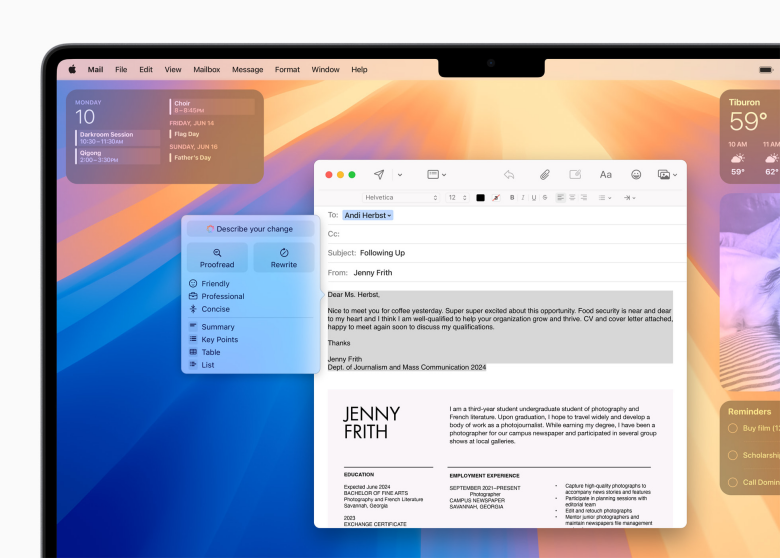
Writing Tools — one of the few genuinely usable Apple Intelligence features, and even then, just okay.
To be fair, Apple's research team is real. This deserves credit.
"The Illusion of Thinking" (June 2025). Controlled puzzle experiments show that all frontier reasoning models (including o3, DeepSeek-R1) experience "reasoning collapse" above a complexity threshold — accuracy goes to zero, reasoning token count actually drops, as if the model gives up. The paper went viral; widely interpreted as "AI doesn't actually reason."
My read: this is less pure research contribution than a precise piece of strategic communication. Apple's subtext: "we're not behind. The companies burning billions on giant reasoning models — those models may not actually be reasoning. Our path — small models, on-device, task-focused — is the more rigorous direction."
Academic reaction was divided. Simon Willison said the paper "got more attention than it deserves" because the title fits the "LLMs are overhyped" crowd. A rebuttal paper "The Illusion of the Illusion of Thinking" turned out to be a joke, but real academic rebuttals exist — many failures were due to output token limits rather than reasoning ability. Apple themselves acknowledged the study used black-box APIs and couldn't observe model internal state, so conclusions don't necessarily generalise.
Beyond the marquee paper:
- Foundation Models Tech Report 2025 (July). 397 co-authors. Detailed architecture for a ~3B-parameter on-device model and a server-side MoE. Includes KV-cache sharing, 2-bit quantisation-aware training. On-device model meets or beats equally-sized open-source baselines.
- MLX framework (open-sourced Dec 2023). ML framework optimised for Apple Silicon, NumPy-style API, Swift/C++/Python bindings. One of the smartest moves Apple's made on developer ecosystem — Mac becomes the best hardware for local AI development.
- ICLR, ICML, NeurIPS, CVPR. Massive paper output, covering vision, privacy, diffusion, RL. Production rivals Google DeepMind and Meta FAIR.
- "The Super Weight in Large Language Models." Found that extremely small parameter subsets (sometimes one parameter) have disproportionate impact on whole-model behaviour.
- Private Cloud Compute. A genuine innovation in private computation — server inference data encrypted in transit, Apple itself can't access user content.
The research team has the talent. The problem is the chasm between paper and product. Many papers shipped. Product hasn't. Classic research-engineering disconnect.
9. What Apple did right
In fairness, the last few years aren't all disaster on the AI side.
1. Silicon. Apple Silicon's Neural Engine is a hard moat. Tests show Apple chips output 100M tokens per dollar; Nvidia H100 only 12M. M5 chip on MLX shows 19–27% faster local inference than M4. This is Apple's strongest moat.
2. Foundation Models Framework (WWDC 2025). Opens the ~3B on-device model to third-party developers via API. Critical point: zero inference cost. Build AI apps inside Apple's ecosystem, pay no API fees. The only platform currently providing free on-device inference at this scale.
3. Privacy architecture. Regardless of what you think of Apple's AI features, Private Cloud Compute's design is industry-leading. On-device-first, server-side encryption, Apple can't see user data — not marketing copy. There's actual implementation.
4. Acquisition strategy (too small though). DarwinAI (DNN compression), Mayday Labs (AI scheduling), Pointable AI (RAG and agents), WhyLabs (ML monitoring), Common Ground (digital twins). All point in correct directions, but the scale is too small. Apple's biggest acquisition to date is still $3B for Beats in 2014. Some analysts say Apple "may need to acquire Anthropic" — but Anthropic's March 2025 valuation was already $61.5B.
5. MLX open-source ecosystem. Makes Mac one of the best platforms to run LLMs locally. Ollama has integrated MLX backend. Real developer pull.
10. $9.5B vs $300B — not the same race
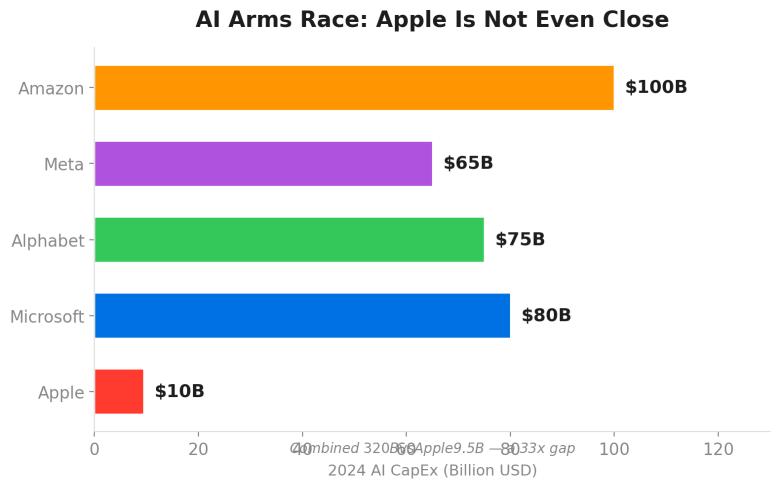
Others poured $300B+ into AI; Apple spent $9.5B — a 33x gap.
Fiscal 2024: Apple capex was $9.5B, 2.4% of revenue.
Same year: Meta, Amazon, Alphabet, Microsoft planned over $300B combined. Amazon alone $100B. Microsoft $80B.
Apple is renting GPUs from Google Cloud to train its models.
The gap isn't just money. It means Apple isn't on the same track for AI infrastructure. The strategy is — let others train the models; we'll do integration and on-device optimisation.
Can that work? Maybe. Apple has never won by doing the base technology — it wins on integration, experience, ecosystem.
But if you're entirely dependent on someone else's models, your ceiling is the ceiling they give you. Apple used to "not do search engines, just use Google" — collected $20B/year in default search fees. Now it "doesn't do foundation models, just uses Google" — pays $1B/year for Gemini. Role change: rent collector → rent payer.
11. External threat — the Ive + Altman combo
Jony Ive's move to OpenAI deserves its own section.
May 2025. OpenAI acquires Ive's company io for $6.4B. Ive runs hardware product design at OpenAI. Altman's framing was clear: this device challenges the phone as the primary interaction entry point.
This isn't just one person leaving Apple. Ive took a cluster of ex-Apple design talent. The io merger means OpenAI now has world-class industrial design capability — exactly the piece OpenAI was missing.
Apple is building its own AI wearable — an AirTag-sized AI Pin with dual cameras and wireless charging, planned for 2027, initial production 20M units. OpenAI's device is reportedly shipping end of 2026. First-mover advantage with OpenAI.
The harder irony: Ive left Apple in 2019. Six years and Apple hasn't shipped another category-defining hardware design. Vision Pro is too expensive and too heavy; AirPods Pro is iteration. The AI-era hardware design language may now be defined by Apple's former designer working with Apple's biggest AI rival.
12. App Intents — a vision developers haven't bought into
Apple Intelligence's ultimate vision isn't Writing Tools or Genmoji — it's Siri working across apps for you. "Find that recipe in Safari and add the ingredients to my shopping list" — Siri understands, calls two apps, completes a multi-step operation.
That vision depends on critical infrastructure: App Intents.
App Intents isn't new. Its predecessor SiriKit shipped in 2016, upgraded to App Intents framework in 2022 for Shortcuts, Spotlight, lock-screen widgets. But the WWDC 2024 "fake demo" lifted App Intents to a new level — it became the interface layer for Siri to understand and operate third-party apps.
The problem: Apple's entire Siri AI upgrade plan depends heavily on third-party developers actively adopting App Intents. That's not something Apple can do alone. Developers have to write code, declare Intents, define Entities, mark Schemas — non-trivial work. And Apple still hasn't shipped a working Siri to test against.
Developers are being asked to write adaptation code for a Siri they've never seen run. Apple's developer docs still say "Siri's personal context understanding, onscreen awareness, and in-app actions are in development and will be available with a future software update." No date.
According to Mark Gurman, Apple is currently working directly with only ~8 top apps. Apple engineers are worried internally: will the system be compatible with enough apps? In high-stakes scenarios like banking and health, will accuracy be enough?
Chicken-and-egg: if developers don't adapt, the new Siri has too few apps to operate. UX won't be good. UX not good — developers lose motivation to adapt.
Compare to WeChat mini-programs: WeChat first built the infrastructure and distribution channels, then used traffic and commercial returns to pull developers in. App Intents today has neither a working Siri nor visible traffic returns for developers. That's why App Intents, while well-designed technically, is moving slowly.
13. Mini Apps — Apple imitated WeChat without learning the lesson
This brings us to Apple's awkward history in the "lightweight apps" lane.
2020: Apple launches App Clips in iOS 14 — instant lightweight app experiences via NFC, QR, or link, for things like ordering or paying for parking. Tech press worldwide: "isn't this WeChat Mini Programs?"
Functionally, yes. The gap is enormous:
WeChat Mini Programs went live in 2017. By 2024, 7M+ mini programs, 400M+ DAU, 1B mini-game users, hundreds of billions in annual transaction volume. A parallel ecosystem to the App Store.
App Clips four years in: a few dozen actively used. Developer adoption extremely low.
2025: Apple launches Mini Apps Partner Program trying to repair App Clips. Mini Apps persist (App Clips auto-delete after 30 days), have fuller developer support, full monetisation. Apple even takes a cut from WeChat Mini Programs — Bloomberg estimates 15%, possibly billions a year.
But the core issue is unchanged: Apple hasn't built a self-growing mini-program ecosystem. Reason is simple — Apple's distribution model is App Store centralised review, while Mini Programs use social-viral + QR-scan decentralised distribution. Two philosophies, two outcomes.
14. The vibe-coding crackdown — Apple's most dangerous arrogance of the AI era
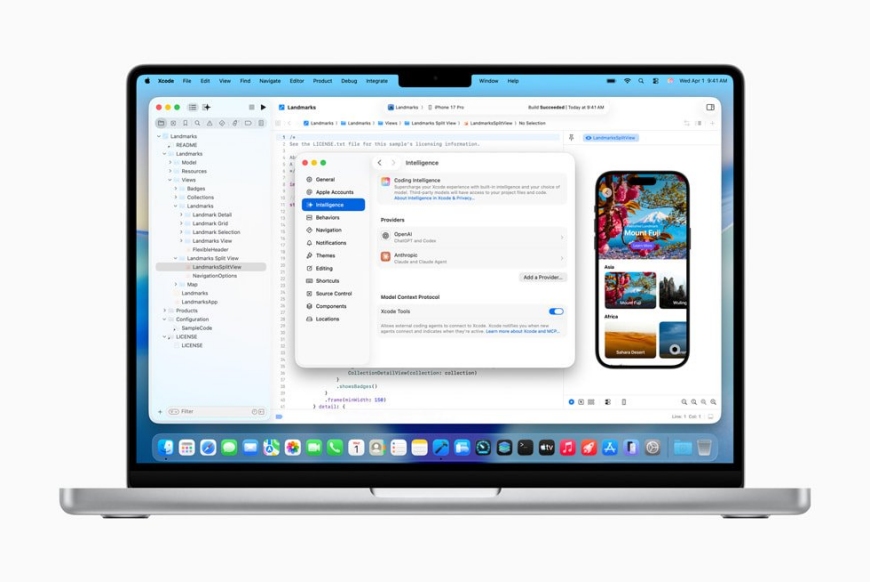
Xcode embraces AI coding, but users can't vibe-code on iPhone — peak double standard.
In March 2026, Apple quietly blocked multiple "vibe coding" apps.
What's vibe coding? A term Andrej Karpathy coined in February 2025 — describe what you want in natural language, AI generates and runs the code. No programming experience required. Conversational software creation. Replit, Vibecode, Anything brought that to iPhone.
Apple acted. The Information's March 18 report: Apple invoked App Store Review Guideline 2.5.2 to block Replit and Vibecode updates. The rule's core is that apps must be "self-contained" and cannot "download, install, or execute code which introduces or changes features or functionality."
Apple's spokesperson: "This isn't a new policy targeting vibe coding apps."
But the underlying logic is clear:
1. Revenue threat. Vibe-coding apps let users create web apps directly on the phone, bypassing the App Store, bypassing the 30% cut. Directly challenges Apple's core business model.
2. Distribution threat. When an app can generate and run infinite new applications internally, it's essentially an alternative App Store that bypasses review. The point of Apple's review evaporates — the reviewed app and the running app are different things. Vibe coding is already stressing the App Store review system — Sensor Tower data shows December 2025 submissions up 56% YoY, a four-year high. Developers complain on Reddit that review takes six weeks. Even Elon Musk recently complained about iOS review speed.
3. Competition threat. Apple itself is embracing AI coding in Xcode harder than anyone. September 2025: Xcode 26 integrated ChatGPT and Claude for code assistance. February 2026: Xcode 26.3 added Anthropic's Claude Agent SDK and OpenAI's Codex, supporting full agentic coding. Apple adopted Anthropic's MCP as the open standard.
Susan Prescott (Apple Developer Relations VP): "Agentic coding supercharges productivity and creativity."
So the logic is: Using Claude Agent to autonomously write code, run builds, modify project settings inside Xcode? Apple endorses. Using Replit to AI-generate an app on iPhone? Apple blocks. Same AI generating code, same execution of unreviewed code. The difference: one uses Apple's toolchain and App Store, the other doesn't.
Concrete consequences:
- Replit ($9B): told to make generated apps open in external browser instead of an in-app WebView to be eligible for updates. Couldn't ship since January. Dropped from #1 to #3 on developer-tool charts.
- Vibecode: told to remove "create apps for Apple devices" feature to pass review.
- Anything: removed from the App Store. Founder tried a browser workaround; rejected.
The contradiction: Apple's WWDC pushes Foundation Models Framework to encourage developers to build AI apps. At the same time, the App Store bans the most active AI developer tools of the era.
Antitrust lawyer Gene Burrus: Apple has a "history of killing competitors on its own platform." Google Play Store: no equivalent restrictions on similar apps.
My read: this may be Apple's most dangerous arrogance in the AI era. Not because Replit or Vibecode are individually critical — but because the trend they represent is irreversible. When non-programmers can create software in natural language, the entire App Store review-distribution-cut model faces a fundamental challenge. Apple can block one Replit, ten Anythings — it cannot block the trend itself.
Anything's case is particularly telling. Launched November, raised $11M in September at a $100M valuation. Users had published thousands of apps via it. From December, Apple started blocking updates. Anything tried a browser-preview workaround; Apple rejected it; March 26 they were removed entirely. No compromise window.
The same week, an Indian vibe-coding app called Emergent with near-identical functionality had its update approved and topped the dev-tools chart. Same rules, different enforcement. Selective enforcement is what chills developers the most.
But Anything didn't fold. On April 3, they announced on X that they had moved app-building into iMessage: "Apple is scared of vibe coding. They removed Anything from the App Store, so we moved app building to iMessage. Good luck removing this one, Apple."
iMessage extensions are Apple's own opening — they can't easily take Messages down. The move puts Apple in an awkward position — killing iMessage extensions would slap their own face; not killing means accepting that vibe coding continues on iOS.
CNBC's column headline got it right: "Apple's crackdown on AI apps puts it on the wrong side of history."
14.5. Siri Extensions — has Apple finally figured it out?
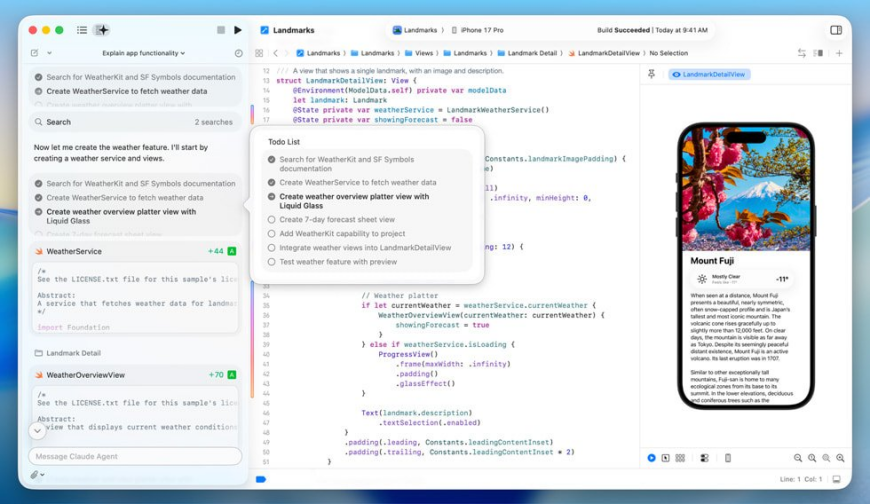
Claude Agent can already write code and run tests autonomously — Siri can't even do cross-app actions.
Same week as the vibe-coding crackdown, Bloomberg's Gurman dropped another scoop: Apple plans Siri Extensions in iOS 27 — allowing third-party AI assistants to plug into Siri.
What does this mean? If you have Gemini, Claude, or ChatGPT installed, you can invoke them through Siri. Siri becomes an AI router, not the only AI.
Beta builds already include the description: "Extensions allow agents from installed apps to work with Siri, the Siri app and other features on your devices." Users toggle which AI services they want in settings. Apple is also planning a dedicated AI section in the App Store.
This may be the smartest move Apple has made in AI strategy.
Reason: Apple has finally accepted a truth — if you can't make the best AI, be the platform for AI. Same as not making the best app but running the App Store. Siri doesn't need to be smarter than ChatGPT. It just needs to be how you call ChatGPT.
And there's commercial logic. Users subscribe to third-party AI through Siri; Apple takes a cut. ChatGPT's exclusivity ends; it competes against Gemini and Claude. Apple shifts from "depending on OpenAI" to "making every AI company pay rent on my platform."
The irony is in the same week: opening up to third-party AI at the Siri layer; cracking down on tools that let users build AI apps at the App Store layer. "Come to my platform" and "only in the way I allow" at the same time.
The logic is internally consistent: welcome AI, but only through my tollbooth.
15. The next twelve months
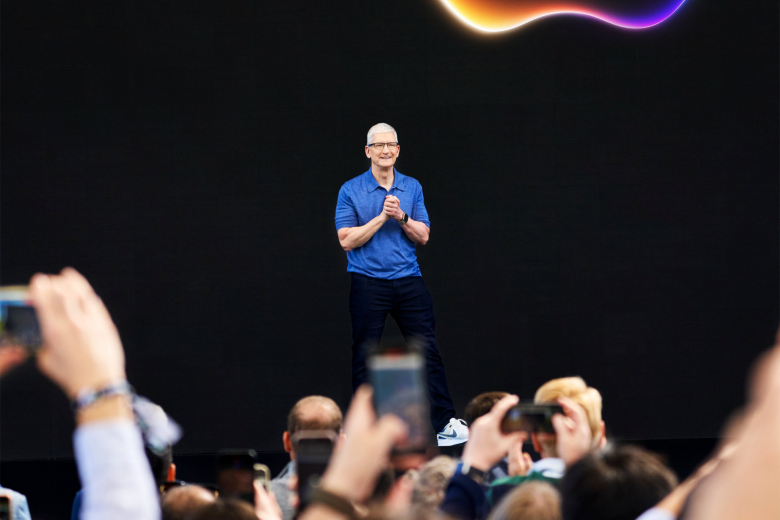
Cook has about 1.5 years to prove Apple's AI isn't an expensive joke.
TD Cowen analysts: Apple has roughly 18 months to present a credible AI plan.
Needham's Laura Martin: Apple is one to two years behind. "If Android is integrating Gemini and generative AI every year, your next phone — one or two years from now — Android's AI experience keeps getting better. Apple starts losing users."
The new Siri (codename Campos, Gemini-powered) is scheduled, if smooth, for iOS 26.5 or 27. If it slips again, if the experience still loses to "just use ChatGPT," Apple faces a situation it has never faced before.
Closing read
Apple's AI dilemma isn't one problem. It's a stack of contradictions.
Technical capability, organisational inability. World-class silicon, prolific papers, healthy MLX ecosystem — but an AI chief who shrugged at chatbots, a Siri lead who spent two years removing one word, two teams logging grievances at each other, a WWDC demo nobody had seen run.
Open in word, closed in action. Push Foundation Models Framework to encourage developers; block vibe-coding tools in the App Store. Promise App Intents as Siri's future without shipping a working Siri to test against.
Hubris. Apple's confidence has been "slow is fast" in every wave so far. That worked on phones, watches, silicon. AI isn't hardware. AI is a contest of speed and scale. More dangerously, vibe coding is shaking the foundations of App Store review-distribution-cut itself. Apple isn't losing to a competitor — it's trying to manage a new world by the rules of the old world.
The good news: Apple is adjusting — new people, new architecture, new strategy. The bad news: the window is roughly 18 months, possibly less. 1.5 billion devices and the world's wealthiest user base are Apple's last cushion. If they don't deliver inside that cushion, Apple's AI story won't be "came from behind" — it'll be "started early, arrived late."