
A new category is breaking out in 2025–2026: AI mini-game communities.
The core formula is simple — AI-generated games + social distribution + UGC community. Users describe a game in natural language; the platform generates a playable version; the community shares, discovers, and remixes each other's work. A create → distribute → recreate flywheel.
This isn't Unity. The target user isn't a professional developer — it's anyone with zero programming background. The product logic is closer to TikTok than Steam: not search → download → install → play, but scroll → play → like → remix → publish. The whole loop is seconds long.
A five-layer stack
Everyone in this category builds on roughly the same five-layer architecture:
- Input layer — natural language / templates
- LLM generation layer — GPT/Claude generates code
- Sandbox runtime — iframe / WebView isolation
- Render engine — HTML5 Canvas / WebGL / Phaser
- Distribution layer — community feed / shareable links
Where each product diverges is how each layer is implemented and which one they double down on. The trade-offs at each layer determine completely different product shapes.
Seven products, deep dive
1. Spielwerk (Minit Games) — the feed-native standard
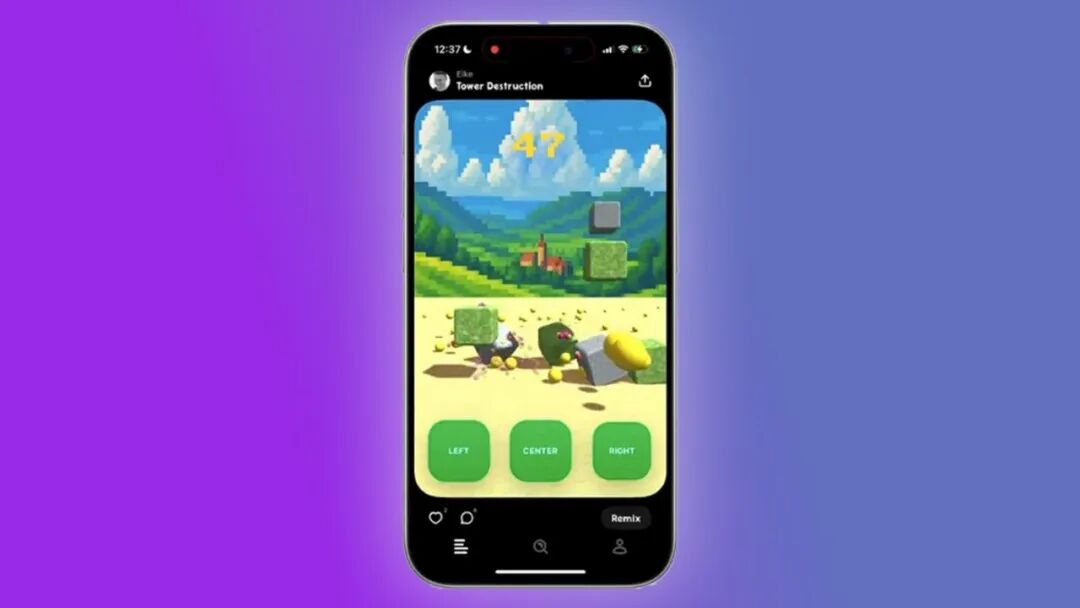
Spielwerk: a vertical, infinite-scroll feed of mini-games — TikTok for games.
Team & funding. Founded by Eike Drescher and Valerie Krämer, ex-Bento (Sequoia portfolio, acquired by Linktree), with prior work on Twitter and Trade Republic. Hamburg-based Minit Games GmbH closed a €1.7M (~$2M) pre-seed in March 2026, co-led by LVP (Europe's top games VC) and Sony Innovation Fund. Sony's participation is the signal — a traditional game incumbent is betting on the short-form-video-style game category.
Product. Open the app, you see a vertical infinite-scroll game feed. The UX is essentially TikTok — one game per screen, swipe to switch. The loop is scroll → play → like/comment → remix (fork) → publish. In-app, describe a game in plain language, the platform uses GPT-5 (per Eike's tweets), 10–30 seconds from prompt to playable. Instant gratification is the core sell — same product philosophy as TikTok's 3-second attention grab.
Tech. Self-built lightweight HTML5 engine optimised for mobile vertical orientation. LLM-generated HTML5 + Canvas runs in an iframe sandbox. No download. The platform's AI recommender matches creators to audiences from real-time signals — at least an order of magnitude more efficient than the search-and-download app-store model.
"Players spend more and more time in algorithm-driven feeds, but games are still trapped in the traditional store model." — Ole Schaper, co-founder
Status. Closed funding in March 2026. Invite-only Alpha right now, gradually rolling out.
2. Gizmo (Atma Sciences) — the social play, acquired by Meta
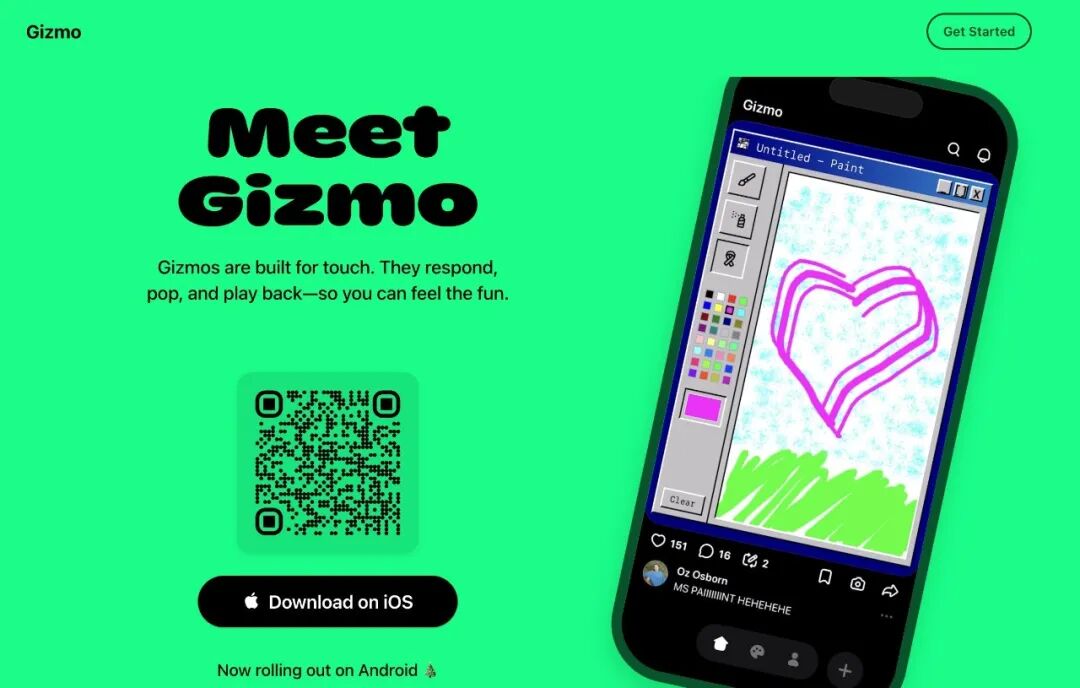
Gizmo: TikTok for interactive content — games, puzzles, interactive art.
Team & funding. Atma Sciences Inc., founded in 2024 by ex-Snapchat engineers — CEO Josh Siegel, CTO Daniel Amitay, Brandon Francis, Rudd Fawcett. The pedigree matters — they bring deep short content + social distribution + mobile UX DNA from Snapchat, and it shows in the product. Raised ~$5.48M from First Round Capital and Uncommon Projects before Meta's acquisition.
Product. TikTok-style vertical feed, but the scope is wider — not only games. Puzzles, memes, interactive art, animations, digital toys. Prompt in, touchable interactive content out, with support for tap / swipe / drag / draw / shake. "A snail you can drag around" becomes a playable mini-experience. Gizmo is "TikTok for interactive content" — if TikTok let everyone make videos, Gizmo wants everyone making interactive experiences.
The acquisition matters more than the product. March 2026: Meta acqui-hired the Gizmo team. Note — not a traditional acquisition. Meta didn't buy the product or user base; they hired the team and got a non-exclusive licence to the tech. The team joined Meta Superintelligence Labs (MSL), led by Alexandr Wang (Scale AI founder) and Nat Friedman (former GitHub CEO).
The strategy is clear: Meta is building a prompt-driven interactive content feed for Instagram and Facebook. Picture an "interactive content" tab next to Reels where you AI-generate and share games and interactive experiences — riding Instagram's 2B MAU distribution. For independent startups, that's a vertical drop. The window for Spielwerk and Remix may be 12–18 months before Meta's integration arrives.
3. Remix (formerly Farcade) — Web3-native game community
Remix: a Web3-native vertical game feed, 800+ games and 500K+ players.
Team & funding. Started in the Farcaster ecosystem; renamed Remix in 2025 to widen positioning. $5M Seed led by Archetype, with Coinbase Ventures and Variant Fund, plus Zynga co-founder Justin Waldron as angel. A $1.75M extension brings total raised to $6.75M. That cap table is a Web3 × games power table — Archetype is top-tier crypto, Coinbase brings chain infra and distribution, Variant focuses on digital ownership, Justin Waldron brings Zynga ops experience.
Product. Mobile vertical game feed. Create via prompt or remix (fork-and-modify). Biggest divergence from Spielwerk: Web3-native. Supports Farcaster and World logins. In-game items and creator earnings are prepped for on-chain settlement. Already 800+ games and 500K+ players. The Snap Apps feature turns high-engagement games into standalone shareable web apps — a smart distribution move letting good games escape the platform's walls.
Distribution breadth. Widest in the category — iOS app, Telegram (TON ecosystem), Farcaster, Base App, World App, soon Coinbase Wallet. The Telegram presence is key — Telegram is dense with crypto-native users, perfectly matching Remix's positioning.
Tech. Dual-track creation — AI prompts for regular users, Game SDK for developers writing HTML5 directly. Standardised postMessage interface for score reporting, leaderboards, identity. Web3 layer on Base (Coinbase's L2) — chain identity and future in-game asset trading. Revenue: ad share + IAP, plus creators selling in-game items and paying for feed promotion.
Risk/reward. If Web3 gaming heats up in 2026–2027, Remix is the biggest beneficiary in this category. If not, it stays in the crypto-native niche.
4. Pieter Levels — the vibe gaming origin story
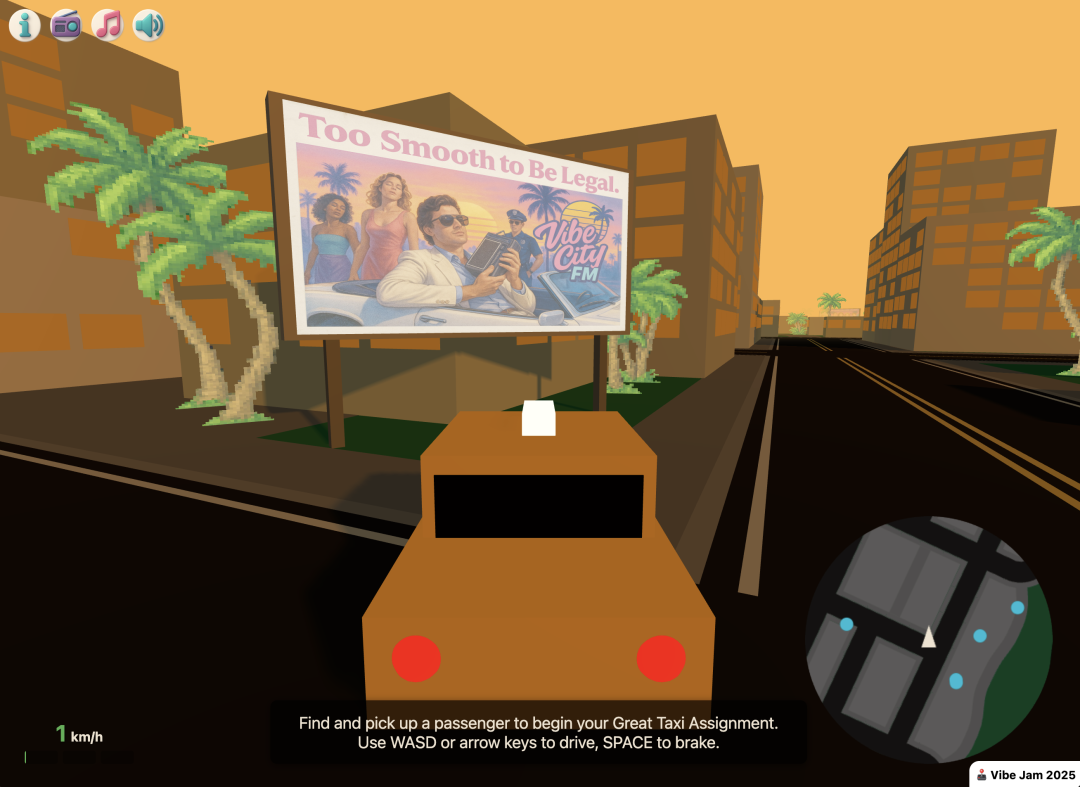
fly.pieter.com: a browser MMO flight sim built in 3 hours; $0 to $1M ARR in 17 days.
Not a platform — a proof. Pieter Levels isn't a company. He's the origin myth of the whole vibe-game movement. In February 2025, the Dutch indie dev spent three hours with Cursor + Claude to ship fly.pieter.com, a browser-based MMO flight sim.
Numbers: $0 → $1M ARR in 17 days. Peak 26K concurrent. 320K+ total players. Now stable at $100K+/mo. He followed up with the 2025 Vibe Code Game Jam — 1,170 entries. That jam detonated the entire category.
Why his story matters. He proved one assumption: one person + AI + a few hours = a six-figure-monthly game. That narrative is the underlying faith of every AI mini-game platform.
But there's a nuance most people skip — Pieter's success leans hard on personal brand. He has 500K+ Twitter followers. Every tweet is free distribution. An ordinary person using the same tools to make the same-quality game would, in expectation, get zero traffic.
That's exactly the problem Spielwerk / Remix / et al. are trying to solve — built-in distribution. You don't need to be a personality. The algorithm finds players for you.
Tech. The simplest possible stack — pure HTML/JS/CSS + Three.js for 3D + Cursor IDE + Claude Sonnet co-coding + Cloudflare Pages. No backend. No database. No App Store review. The anti-engineering of the stack is itself a product statement.
5. Rosebud AI — the tooling leader
Funding. $25M Series A at the end of 2024, valuation up 40% on the previous round. Forbes "AI 100" list, "AI Startups to Watch 2025." Largest raise in the category for a pure tool play.
Product. Web-based AI game engine. Chat-first interface — describe the world, camera angles, lighting, character models, gameplay mechanics in natural language. AI agents generate scenes, physics, interaction logic, UI, even test levels.
Fundamental difference from Spielwerk / Gizmo: those are consumption platforms (scroll games). Rosebud is a creation tool (build games). The audience is creators with some development sense or clear design vision. Supports richer game types — RPG, strategy, simulation, 3D worlds.
Differentiation.
- Stripe-native monetisation. Tip Jar and IAP, platform takes a cut (Roblox-shaped).
- Code export. Unlike Spielwerk's closed platform, Rosebud games can export source and run independently.
- PixelVibe. Self-built AI 2D asset generator — character sprite sheets, props, scene elements, with automatic frame animations.
- 2D + 3D dual track. Phaser (2D) and Three.js (3D) both supported.
Tech. Multi-agent collaboration — different specialised agents handle different sub-domains (scene design, physics, UI, asset generation). User's natural language is routed to the right agent, and each generates the corresponding code and assets. Final assembly is a complete game. Higher quality and more controllable than a single LLM trying to generate everything at once.
6. SEELE AI — the 3D engine from a Chinese team

SEELE: end-to-end AI 3D game generation with Unity export.
Funding. Shenzhen-based, backed by Baidu Ventures and Meitu. Bloomberg reports a new round in progress, valuation pushing nine figures. The only company in this category with a major Chinese internet incumbent on the cap table — meaningful for distribution and compute access in China.
Product. Web-based IDE. The biggest differentiation: end-to-end AI asset generation. Other products (Spielwerk, Remix) are primarily 2D; Rosebud attempts 3D; SEELE is the most aggressive 3D player.
SEELE generates 3D models, 2D sprites, PBR materials (Diffuse, Roughness, Metallic, Normal, AO), skeletal animations, BGM, and voice acting — all inside the platform, all AI. Speed: 2D games 2–5 min, 3D games 2–10 min, single 3D asset 30–60s (1K–300K triangles, 512px–4K textures). Supported types: FPS, RPG, 3D platformer, racing, simulation, open-world sandbox.
Moat. Self-built EVA-01 multimodal foundation model optimised for 3D game assets. Layered on Baidu's Ernie X1 and 4.5, plus Baidu Cloud and Kunlun AI chips for scale.
Dual-engine architecture. Three.js (WebGL) browser preview, plus Unity project export (C# scripts, FBX models, physics components configured). Unreal Engine 5 support targeted Q2 2026 — at which point SEELE would be the only platform supporting Three.js + Unity + UE5.
Creators start in SEELE for fast prototyping without lock-in — export to mainstream engines to continue. This is the structural difference between SEELE and Spielwerk/Gizmo — SEELE is the starting point, the others are the destination.
7. Roblox — the AI pivot of the incumbent
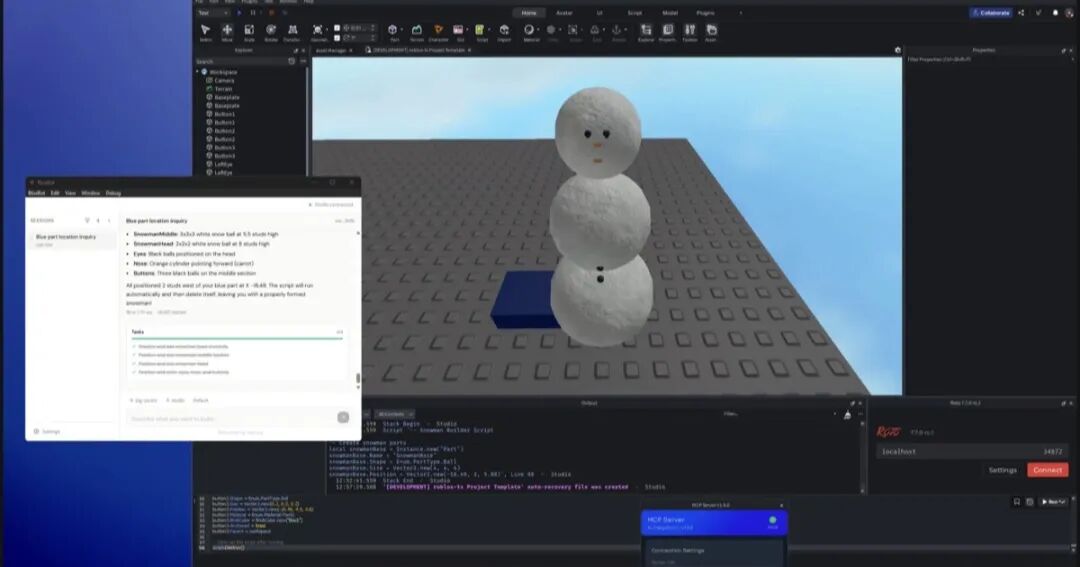
Roblox: 85M+ DAU, a self-built AI foundation model, and Cube 3D/4D generation.
Why it's the elephant. 85M+ DAU. Self-built AI foundation model. Multi-billion-dollar annual creator payouts. 17 years of proving UGC games as a business model. New entrants either build lighter Roblox or pick a niche Roblox won't bother with.
Cube foundation model — from 3D to 4D. Roblox's AI strategy is built on Cube — tokenise 3D shapes (convert geometry to discrete tokens), then apply GPT-style autoregressive Transformers for text→shape and shape→shape generation. Open-sourced. Since launch in March 2025, Cube 3D has generated 1.8M+ 3D objects.
The frontier is 4D generation — public beta from February 2026. 4D adds behaviour and interaction to the 3D model. Prompt "a race car" and you don't just get a model — you get a complete car you can drive. 160K+ 4D objects in early access. Players using 4D-generated content spend 64% longer in-game on average. 4D uses a Schema template system — e.g. Car-5 Schema defines the body-plus-four-wheels framework, AI generates the geometry, material, and physics within it.
Real-world AI impact. AI-tool users publish 31% more content YoY. AI-assisted new game development is 35–40% faster.
Where the window stays open for newcomers. Roblox's strengths are also its baggage — heavy client (wrong for scroll-game feeds), Lua scripting threshold (even with AI assist, harder than pure prompts), child-skewed aesthetic (Z-cohort is ageing out). Newcomers can play in the gaps — lighter (web-native), more mobile (vertical feed), more adult-aesthetic, more Web3-native.
The positioning spectrum
These products line up on a consumption ↔ creation spectrum:
- Pure consumption (left): Spielwerk, Gizmo — players and browsers, TikTok-shaped.
- Hybrid (middle): Remix, Pieter Levels — creators are also users, creation and consumption co-located.
- Pure creation (right): Rosebud, SEELE — developer-facing, Unity/Unreal-shaped.
- Full spectrum: Roblox — both giant player base and pro developers; spans the whole spectrum.
One interesting consequence — products at opposite ends don't directly compete. Spielwerk (feed) and SEELE (tool) both "make AI games" but they're entirely different products. Different ceilings, different user profiles, different business models.
Four technical challenges
-
The game-quality ceiling. AI-generated games today are mostly simple 2D. A long way from AAA. Spielwerk's Cheats system (preset templates constraining LLM output space) and Rosebud's multi-agent collaboration (dedicated quality agents) are two different solutions to the same problem.
-
Sandbox safety. UGC platforms run user-generated code — must defend against malicious code (XSS, infinite loops, memory leaks). Gizmo picks Claude (safer LLM) plus two-layer review. Roblox uses restricted Luau. Feed mode also demands sub-1-second game load, which puts extreme demands on sandbox cold-start performance.
-
3D generation quality. The biggest technical moat right now. SEELE's EVA-01 (PBR-material 3D in 30–60s) and Roblox's Cube (3D tokenisation + 4D behaviour) represent two different paths. Spielwerk / Gizmo / Remix sidestep 3D for fast 2D Canvas — short-term smart, long-term 3D is contested ground.
-
Content moderation. UGC platforms must handle inappropriate content. AI-assisted moderation plus community reporting is the standard combo.
Five trend predictions
-
Incumbents pile in fast. Meta acquiring Gizmo is the start, not the end. Google, Apple, Tencent will move via acquisition or build. Once an Instagram interactive-content feed ships, independent startups face billion-user distribution head-on.
-
Remix/fork becomes a standard primitive. Like GitHub normalised code forking, AI game platforms will normalise game remixing. The moat isn't having the feature — it's the size of the remix network effect: most remix templates × most active creators × best recommender.
-
The feed / tool split widens. Spielwerk and SEELE both do "AI games" but the ceilings are different. Feed's ceiling is UGC content platform (reference: TikTok). Tool's ceiling is game engine (reference: Unity). They will not compete directly.
-
Multi-modal generation explodes. From text prompts to voice, image, video input. Quality jumps. SEELE's EVA-01 and Roblox's 4D are already exploring this.
-
Creator economy matures. YouTube-style ad share, Roblox-style developer share — both become table stakes. Rosebud's Stripe-native monetisation, Remix's on-chain economy, Spielwerk's algorithmic distribution — each is building its own creator-incentive flywheel.
Closing
Writing this up, one thing stuck out: all seven products are doing the same thing — lowering the barrier to creation. Spielwerk reduces game dev from Unity to typing. Roblox lets a 12-year-old build 3D worlds. Rosebud puts non-programmers on Steam.
Games are only one slice of the software world. The same compression is coming for everything else — utilities, social apps, productivity tools, personal experiences. The category that wins the AI mini-game community shape will also light the way for every other category that asks the same question: what if the creator could just describe it?